Customer Winback Campaigns: A Practical Playbook for Bringing Customers Back
By EcomBlaster Team · 6 min read · Sep 28, 2026
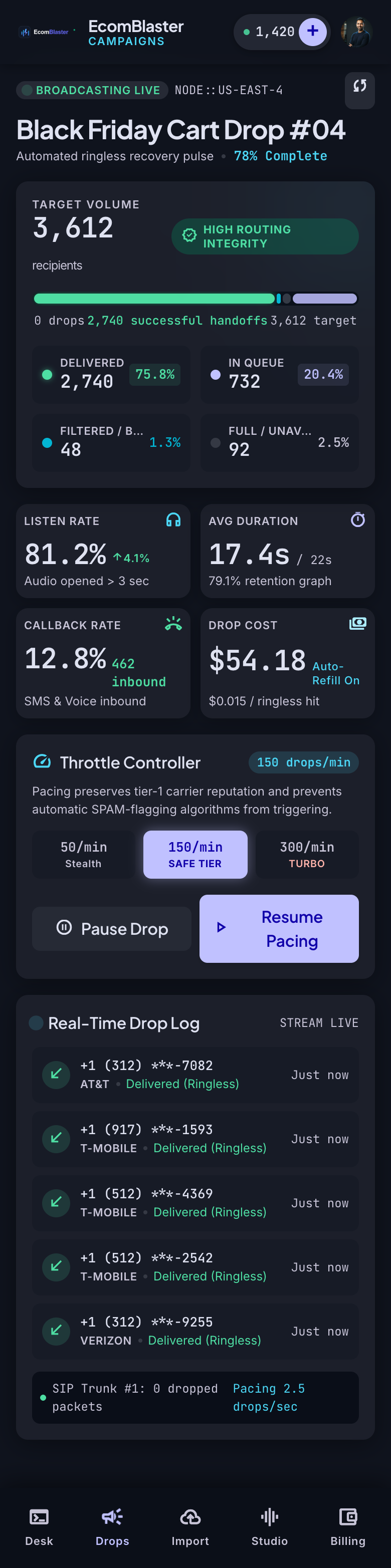
Every store owner knows the feeling: a customer buys once, loves the product, and then disappears. Acquiring that customer cost real money, and letting them drift away means paying for the same attention twice. That is exactly the problem customer winback campaigns solves. In this guide we break down how winback campaign works in practice, which channels carry the message, and how to prove in plain numbers that it made more money than it cost.
Why winback campaign matters more than ever
Ad costs keep climbing, inboxes are crowded, and attention is the scarcest resource in e-commerce. Meanwhile, the customers most likely to buy from you are the ones who already did. Repeat customers convert at dramatically higher rates than first-time visitors, they spend more per order, and they cost nothing new to reach. According to widely cited industry research, improving retention by even a few percentage points can lift profits far more than the equivalent spend on acquisition.
The challenge is not convincing store owners that retention matters. The challenge is time. Nobody has hours every week to export spreadsheets, write individual messages, and remember who should hear what. Customer Winback Campaigns done well is a system, not a chore: it runs in the background, reaches the right people on the right channel, and reports back with revenue, conversion rate, and ROI. You can read a broader perspective on the economics in Shopify's customer retention guide, and the rest of this article turns those ideas into concrete steps.
The three channels that carry customer winback campaigns
Email: the workhorse
Email does the heavy lifting. A personal winback email can include the customer's name, the products they bought, and a single clear call to action with an offer code. It costs almost nothing to send, it is easy to test, and every click and order is measurable. Most successful customer winback campaigns programs start with a simple three-email sequence: a friendly check-in, a reminder with the offer, and a last-chance note before the code expires.
SMS: the nudge
Text messages are short, immediate, and almost always seen within minutes. SMS shines as a follow-up step: if the email did not bring the customer back within a few days, a brief text with the same offer code often does. Keep texts under a couple of sentences, send them at respectful local times, and always honor opt-outs instantly. Used this way, SMS adds meaningful recovered revenue without ever feeling pushy.
Voice: the personal touch
For the moments that matter most, a friendly voicemail drop feels like a real person remembered them, without ever ringing their phone. A warm thirty-second message saying you miss them and that a discount is waiting stands out precisely because so few brands do it. Voice works best as the final step of a sequence for your highest-value lapsed customers, where the extra cost per message is easily justified by the larger orders those customers place.
A simple customer winback campaigns playbook you can run this week
- Pick the audience. Start with customers who bought once but have not ordered in 30, 60, or 90 days. Exclude anyone who opted out, and skip people with an open support issue.
- Write one friendly message. Say who you are, say you noticed they have been away, and give them one clear reason to return. Merge tags add their name and a unique offer code automatically.
- Choose the channel sequence. A proven starting point is email on day one, an SMS on day four, and a voicemail drop on day eight for your best customers.
- Attach a real offer. Ten to fifteen percent off or free shipping both work well. Give the code an expiry date so there is a reason to act now.
- Send at good local times. Late morning and early evening in the customer's own timezone consistently outperform middle-of-the-night blasts.
- Review the numbers, then repeat. After each send, check delivered, orders, revenue, and ROI. Keep what works, rewrite what does not, and run the improved version next week.
What to measure (and the numbers that matter)
Customer Winback Campaigns only earns its place in your budget if the numbers are visible. The metrics that matter are refreshingly simple:
- Delivered rate: how many messages actually reached customers across email, SMS, and voice.
- Conversion rate: the share of reached customers who placed an order using your offer code.
- Recovered revenue: total order value attributed back to the campaign.
- Cost per recovered customer: what you spent in credits divided by the number of returning buyers.
- ROI: recovered revenue versus campaign cost. Healthy winback campaigns routinely return several dollars for every dollar spent.
Tip: always use a unique discount code per campaign. It turns attribution from a guess into a fact, and it tells you exactly which message, channel, and audience earned the order.
Common mistakes to avoid
The fastest way to waste a good list is to message everyone the same way. A customer who bought last month needs a different note than one who has been gone for a year, and segmentation is what separates polite reminders from spam. The second mistake is frequency: more messages do not mean more orders. Two or three well-timed touches beat five desperate ones. Third, never skip the opt-out. Respecting unsubscribes across every channel protects your sender reputation, keeps you compliant, and is simply the right thing to do. Finally, do not fly blind on cost. Know exactly how many credits a campaign needs before it sends, and compare that cost against the revenue it recovers every single time.
Putting it on autopilot
Once the playbook works manually, automation multiplies it. Welcome emails can greet every new customer the day they join. A thank-you message can follow each first order. Winback sequences can watch for customers crossing the 30-, 60-, or 90-day line and reach out without you lifting a finger. This is where a platform like EcomBlaster earns its keep: you write the message once, choose the sequence of email, SMS, and voice steps, connect Shopify or WooCommerce, and the system sends, tracks, and reports around the clock. If you are comparing options, our simple pricing shows exactly what each plan includes, and the blog has more playbooks like this one.
Frequently asked questions
How soon should I contact a lapsed customer?
Thirty days after their last order is a good default for consumables; sixty to ninety days suits longer purchase cycles. Test both and let the conversion data decide.
Which channel should I start with?
Start with email because it is cheap and forgiving. Add SMS as a follow-up step once the email works, then add voice for your highest-value segments.
What size offer actually works?
Ten to fifteen percent off is the reliable middle ground. Bigger discounts rarely recover enough extra orders to pay for themselves, while tiny ones are easy to ignore.
The bottom line
Customer Winback Campaigns is not a trick or a hack. It is the habit of personally, politely, and automatically reminding past customers that you would love to see them again, then measuring what that reminder earned. Stores that build this habit stop renting their growth from ad platforms and start owning it. Start free with EcomBlaster, connect your store, and send your first campaign this week. Questions? Talk to us and we will help you pick the right first play.
Want this to bring back sales?
Start free, connect your store, and send your first email, SMS, and voice campaign with an offer code.
Try EcomBlaster